Choosing a career after graduation can be confusing when you have dozens of options but no clear idea which skills will remain useful. A Digital Marketing Career can be worth considering if you enjoy creativity, communication, technology, research, and working with measurable results. Unlike some careers that require years of specialized education before you can enter the field, digital marketing allows students to start learning practical skills while studying.
From SEO and social media to paid advertising, content, email marketing, and analytics, there are several directions you can take. The field also includes opportunities in agencies, companies, startups, freelancing, and remote work. However, digital marketing is not an easy shortcut to a high salary. Your opportunities depend heavily on your skills, practical experience, portfolio, specialization, and ability to adapt.
Why Is Digital Marketing Career a Good Option in 2026?
The biggest advantage of digital marketing is the variety of work available within one field. A student who enjoys writing may prefer content marketing, while someone interested in data may enjoy analytics or performance marketing.
Businesses use digital channels to reach potential customers, communicate with existing customers, generate leads, and sell products or services. This creates demand for people who understand how these channels work together. A beginner can start with one skill and gradually build a broader marketing profile.
For example:
- Learn SEO fundamentals.
- Practice keyword research and content optimization.
- Create a small website or blog.
- Learn analytics and performance measurement.
- Add social media or paid advertising skills.
- Build a portfolio using practical projects.
This approach is generally more useful than collecting certificates without being able to demonstrate what you can actually do.
Digital Marketing Jobs and Career Paths
One reason students consider digital marketing is the number of possible career paths. You do not have to remain in the same specialization throughout your career.
1- SEO Specialist
- An SEO professional works on improving a website’s visibility in search engines. Typical activities include keyword research, on-page optimization, technical SEO, content planning, internal linking, and analyzing search performance.
- SEO can be a good choice if you enjoy research, websites, writing, and problem-solving.
2- Social Media Specialist
Social media professionals plan content, manage social accounts, study audience behavior, and track engagement. Creativity is important, but successful social media marketing also requires an understanding of analytics and business objectives.
3- Performance Marketing Specialist
Performance marketers work with paid campaigns and focus heavily on measurable outcomes. Platforms such as Google Ads and social advertising platforms are commonly used. This path can suit students who enjoy numbers, testing, optimization, and data-driven decision-making.
4- Content Marketer
Content marketing involves creating useful content that supports business goals. This can include blog posts, videos, guides, newsletters, social media content, and other formats. Strong communication and research skills are particularly valuable here.
5- Digital Marketing Manager
With experience across multiple areas, professionals can move into broader marketing roles where they coordinate campaigns, budgets, channels, content, and teams.
Required Skills for a Digital Marketing Career
You do not need to master everything before applying for your first job. Instead, develop a strong foundation and then specialize.
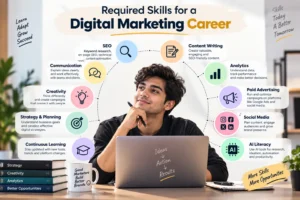
Important skills include:
SEO: Understand search intent, keyword research, on-page SEO, technical basics, and content optimization.
Content writing: Learn how to explain ideas clearly while matching the reader’s search intent.
Analytics: Understand traffic, conversions, engagement, and campaign performance.
Paid advertising: Learn the fundamentals of campaign structure, targeting, budgets, and optimization.
Social media: Understand content formats, audience behavior, engagement, and platform-specific strategies.
Communication: Be able to explain your work and recommendations to clients or team members.
AI literacy: Learn how AI tools can support research, ideation, analysis, and repetitive marketing tasks.
The most valuable combination is often technical understanding + communication + practical experience.
Digital Marketing Salary: What Should Students Expect?
Salary is one of the first things students ask about, but there is no single salary figure that applies to every digital marketing professional.
Compensation can vary based on:
- Location
- Experience
- Specialization
- Company size
- Industry
- Technical and analytical skills
- Portfolio quality
- Ability to generate measurable business outcomes
An entry-level SEO executive and an experienced performance marketing specialist, for example, may have very different responsibilities and compensation. Instead of choosing a course because it promises a particular salary, evaluate whether it helps you develop skills that employers actually need. A practical portfolio can also make your profile stronger. You could create a small website, conduct an SEO audit, build a sample content strategy, or document a mock advertising campaign. These projects give you something concrete to discuss during interviews.
How AI Is Changing Digital Marketing in 2026
AI is changing how marketers perform many routine tasks. It can assist with brainstorming, content outlines, data analysis, research, reporting, personalization, and workflow automation. That does not mean every digital marketing job will disappear. It does mean the nature of the work is changing. For students, the smarter approach is to learn how to work with AI rather than compete with it on repetitive tasks.
For example, an AI tool may help generate initial content ideas, but a marketer still needs to understand:
- What the audience actually needs
- Whether the information is accurate
- What search intent means
- How a brand should communicate
- Which content deserves to be published
- Whether the campaign is producing useful results
Human judgment remains important because marketing is ultimately connected to people, businesses, and decisions.
Future Opportunities in Digital Marketing
The future of digital marketing is likely to reward professionals who can combine multiple skills instead of depending on one platform. A person who understands SEO, content, analytics, conversion optimization, and AI-assisted workflows may have more flexibility than someone who knows only one tool.
There are also different working models to consider:
- Full-time agency jobs
- In-house marketing teams
- Freelancing
- Remote marketing roles
- Consulting
- Personal projects and websites
- Entrepreneurship
Students should also expect continuous learning. Platforms, algorithms, advertising products, consumer behavior, and AI tools can change. A skill learned once may need to be updated later.
How Students Can Start a Digital Marketing Career
You do not need to wait until graduation to begin building experience.
A simple starting plan is:
Step 1: Learn the fundamentals
Understand SEO, content, social media, paid advertising, email marketing, and analytics.
Step 2: Choose one specialization
Start with an area that matches your interests rather than trying to become an expert in everything.
Step 3: Build a real project
Create a website, social media page, newsletter, or mock marketing campaign and document your work.
Step 4: Measure results
Learn to understand traffic, rankings, engagement, leads, conversions, and other relevant metrics.
Step 5: Create a portfolio
Show your process, decisions, work samples, and lessons learned.
Step 6: Apply for internships or entry-level Digital Marketing Jobs
Practical experience can help you understand how marketing works in real business situations.
The goal is not simply to say, “I completed a digital marketing course.” Your goal should be to show, “Here is what I know, here is what I built, and here is how I approach marketing problems.”
Common Mistakes Students Should Avoid
A few mistakes can slow down your progress.
- First, avoid learning every tool without understanding the fundamentals. Tools change; core marketing principles are more transferable.
- Second, do not depend entirely on certificates. Certifications can demonstrate learning, but they do not automatically demonstrate practical ability.
- Third, avoid expecting instant income from freelancing. Finding clients requires communication, networking, positioning, delivery, and persistence.
- Finally, do not treat AI-generated content as automatically ready for publication. Review facts, improve originality, understand the audience, and add genuine value before publishing.
Frequently Asked Questions
1. Is digital marketing a good career for students in 2026?
Yes, it can be a practical career option for students who are interested in marketing, technology, communication, creativity, or analytics. The field offers several specializations, so students can begin with one skill and expand their expertise over time.
2. What are the best Digital Marketing Jobs for beginners?
Common entry-level options include SEO executive, content writer, social media executive, PPC trainee, digital marketing executive, and marketing intern. The best role depends on your interests and the practical skills you have developed.
3. What skills are required for a digital marketing career?
Useful skills include SEO, content creation, analytics, social media marketing, paid advertising, communication, research, and basic data interpretation. AI literacy is increasingly useful because modern marketers can use AI to improve productivity and workflows.
4. Can I start digital marketing without a degree?
A degree can be useful for many jobs, but digital marketing also places significant value on practical knowledge and demonstrable skills. A strong portfolio, relevant projects, internships, and communication abilities can help you build credibility.
5. Does AI threaten digital marketing careers?
AI is changing many marketing tasks, particularly repetitive work. However, marketers still need strategy, judgment, creativity, audience understanding, fact-checking, communication, and decision-making. Learning to use AI effectively can therefore be an advantage.
6. Is freelancing possible after learning digital marketing?
Yes. SEO, content, social media management, paid advertising, and other marketing services can be offered as freelance services. However, beginners should first develop a portfolio and understand client communication, pricing, project scope, and delivery.
7. Which digital marketing specialization should a student choose?
Choose based on your strengths. If you enjoy research and websites, SEO may suit you. If you prefer numbers and experimentation, performance marketing may be interesting. Strong writers may enjoy content marketing, while creative communicators may prefer social media.
8. What is the future of digital marketing?
Digital marketing will continue to evolve alongside search, social platforms, analytics, automation, and AI. Professionals who continuously update their skills and understand marketing fundamentals are better positioned to adapt to these changes.